Willie’s dream (2021)
Fullerton Carriage House, Newburgh, NY
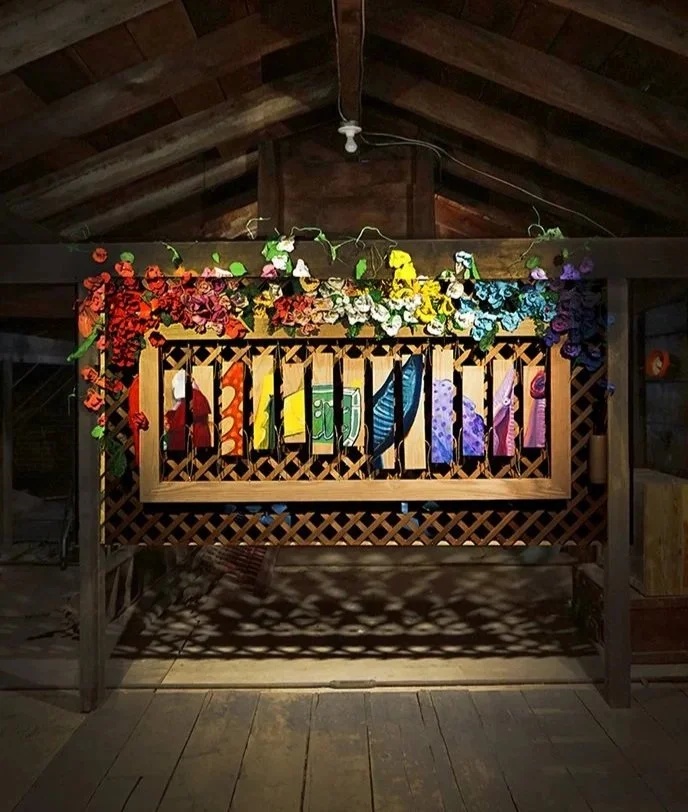
Willie’s Dream, 2021
Collaboration with Chihiro Shibayama × Kate Bae
Acrylic, twine and wood
52 × 94 × 6 inches
Fullerton Carriage House
Willie’s Dream is a collaborative installation with percussionist Chihiro Shibayama that traces the life and legacy of Newburgh-born composer William Fullerton Jr. (1854–1888). Centered on his relationship with stage designer Percy Anderson (1851–1928), the work reimagines a largely forgotten history of artistic and personal connection.
Suspended acrylic slats function as both sculptural elements and playable instruments. When struck sequentially from left to right, they produce the melody of The Locket Song from Fullerton Jr.’s opera Lady of the Locket, allowing visitors—regardless of musical training—to activate the composition through touch.
The work emerged during the COVID-19 pandemic, at a time marked by isolation and rising anti-Asian violence. In this context, participation becomes central: simple acts of tapping, listening, and playing together open a space for shared presence.
Bridging sound and form, the installation invites interaction as both remembrance and encounter. Rather than addressing prejudice directly, it offers an alternative register—where joy, however brief, becomes a quiet form of resistance.
Project Background
Willie’s Dream emerged during the COVID-19 pandemic, when Chihiro Shibayama and I were both working as customer service representatives for the U.S. Census Bureau, our artistic practices abruptly paused.
The New York Census office became an unexpected meeting ground—a multilingual environment where fourteen languages were spoken, and workers from vastly different backgrounds gathered under strict conditions. With personal belongings prohibited, we were left with only our bodies, time, and attention.
In brief moments of pause, Chihiro would tap rhythms on desks and keyboards. Others joined—dancing, singing—before we returned to silence and routine. These fleeting acts of collective creativity, formed under constraint, became the seed of the work.
What began as an impulse to bring sound into my visual practice gradually expanded into a collaborative installation. The project eventually found its site at the birthplace of composer William Fullerton Jr., linking these small, improvised moments to a specific historical context.
Process & Context
The installation developed through trial and repetition. Early iterations struggled to resolve how the suspended slats could function both structurally and musically. When the system finally aligned—when sound and form met through activation—the work came into focus.
This project also reflects a longer trajectory in my practice: a desire to bring sound into painting. Music carries an immediate, bodily resonance, and I was drawn to embedding that quality within a visual structure that can be activated by anyone.
The work emerged during a period of instability and heightened vulnerability. As an Asian woman during the pandemic, I experienced repeated acts of verbal and physical harassment. Rather than addressing this directly, the work turns toward another possibility—creating a space grounded in participation, resonance, and shared presence.
In these moments, sound becomes something shared—brief, unscripted, and held between strangers.
Installed at the Fullerton Carriage House, Willie’s Dream remains open to the public, where visitors engage the work through touch and sound.

